

Quick answer: A garage door opener that beeps every 30 seconds almost always has a low or dead backup battery. On LiftMaster and Chamberlain openers, a flashing orange battery light with the 30-second beep means the battery is low, and a solid red light means it can no longer recharge. Genie battery backup models also beep when the battery weakens. To fix it, confirm the sound is coming from the opener, read the battery light, rule out a power problem at the outlet, replace the battery with the manufacturer’s part, and test it. For most openers, it’s a ladder-and-screwdriver job.
Key Takeaways
- Flashing orange plus a beep every 30 seconds means low battery. A solid red light means the battery can’t recharge and needs replacing.
- Rule out your smoke and CO alarms first. They chirp every 30 or 60 seconds on a low battery, which sounds almost identical.
- Test the outlet before you buy a battery. A battery can’t recharge if the opener has no wall power.
- Use the battery your manual lists. Genie advises against using batteries it doesn’t supply, and the wrong battery may not fit or charge.
- Unplug the opener and close the door before opening the battery compartment.
- Plan on a new battery every few years. Genie designs its replacement batteries to last about 3 to 5 years, recommends testing every 6 months, and old lead-acid batteries belong at a recycler, not in the trash.
Step 1: Make Sure the Beep Is Coming From Your Opener
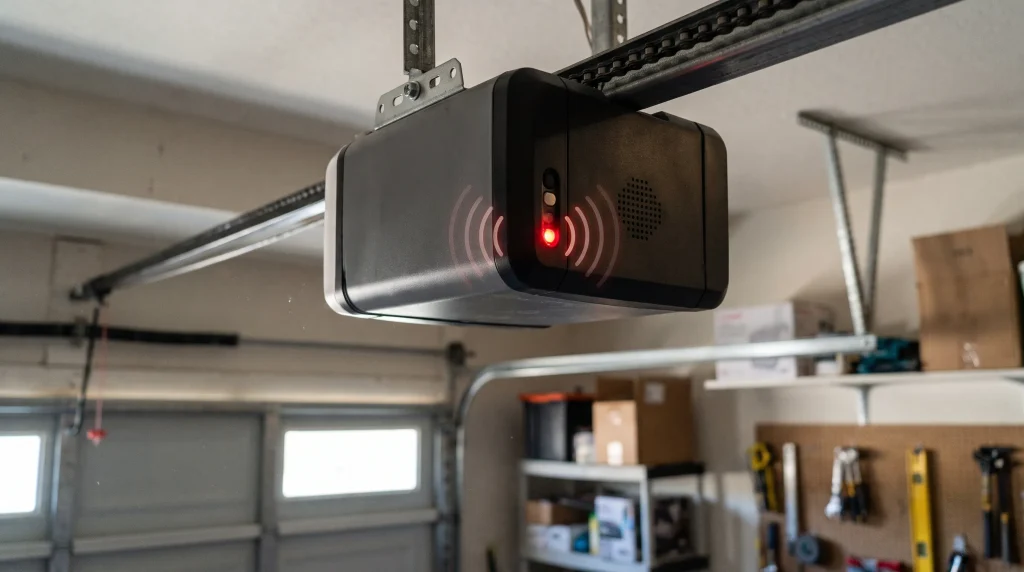
How to tell a garage door opener low battery beep from a smoke alarm chirp
What to look for: A single short beep about every 30 seconds, while the door opens and closes normally.
What it means: If your opener has a battery backup, this is its low battery warning. If it doesn’t, Chamberlain’s troubleshooting guide points to other devices instead: smoke alarms, carbon monoxide alarms, water softeners, and other warning devices with low batteries. Smoke and CO alarms chirp once every 30 or 60 seconds when their batteries are low, so the two are easy to mix up.
How to do it:
- Stand directly under the opener and wait for the next beep. Then do the same under each smoke and CO alarm in and near the garage.
- Look for a battery status light on the opener’s motor unit. If you can’t find one, check your owner’s manual to see whether your model has a battery backup at all.
- Time the beeps. Every 30 seconds points to a low battery. A beep every 2 seconds means the opener is running on battery power. Beeping with flashing lights right before the door closes is a timer or app warning, not a battery problem.
If your beep doesn’t match a battery warning, our master guide, Why Is My Garage Door Opener Beeping? 7 Common Causes and How to Stop It, walks through every cause.
Safety note: Three loud beeps in a row means smoke or fire, and four loud beeps means carbon monoxide. Get everyone outside and call 911.
Call a pro if: you’ve checked every alarm and device in the area and still can’t pin down where the sound is coming from.
Step 2: Read the Battery Status Light
What the flashing orange, red, and green lights on a garage door opener mean
What to look for: On LiftMaster and Chamberlain openers with battery backup, the battery light sits near the top of the Learn button on the motor unit. Genie battery backup models have indicator lights on the powerhead, and your manual explains each one.
What it means:
- Flashing orange with a beep every 30 seconds: the battery is low.
- Solid red: the battery has drained and can’t recharge. If the red light and the 30-second beep continue while the power is on, the battery needs replacing.
- Solid orange with a beep about every 2 seconds: the opener lost wall power and is running on the battery. That’s a different problem, covered in Why Is My Garage Door Opener Beeping After a Power Outage? 6 Things to Check.
- Flashing green: the battery is charging.
- Solid green: the battery is fully charged.
How to do it:
- Check the light with the opener plugged in and the door at rest.
- Note the color and whether it’s flashing or solid.
- If it’s flashing orange or solid red, move on to Step 3 before buying anything.
Quick fix while you wait: To stop the beeping until the new battery arrives, unplug the opener, disconnect the battery, and plug the opener back in. The door will run normally on wall power, but you won’t have outage protection until the new battery is in.
Call a pro if: the light is off entirely on a model that should have one, or it shows a pattern your manual doesn’t list.
Step 3: Rule Out a Power Problem
How to check the outlet, GFCI, and breaker before replacing the battery
What to look for: The outlet the opener plugs into, usually on the ceiling near the motor unit.
What it means: A battery can only recharge when the opener has wall power. Chamberlain’s troubleshooting advice is to test the outlet with a different device first. If the outlet has power and the light still doesn’t switch to flashing green, it’s time to replace the battery.
How to do it:
- Unplug the opener and plug in a lamp or phone charger.
- If the outlet is dead, press Reset on any GFCI outlet in the garage. A GFCI in another spot can protect the opener’s outlet, so check them all.
- Check your breaker panel for a tripped breaker.
- Plug the opener back in and watch the battery light.
- If the whole neighborhood is dark, the opener is running on its battery. Save your trips until power returns.
If the battery dies before the power comes back, pull the red emergency release cord to disconnect the door and move it by hand. Pull the cord with the door closed when you can. If the door feels far heavier than normal, stop and read our guide to manually opening a garage door with broken springs before lifting any further.
Call a pro if: the outlet has power but the light never turns flashing green, even with a new battery installed. The opener’s charging circuit may be failing, which calls for garage door opener repair. If a breaker or GFCI keeps tripping, call an electrician.
Step 4: Replace the Backup Battery
How to replace a LiftMaster, Chamberlain, or Genie backup battery safely
What to look for: The battery compartment, usually behind a cover on the motor unit. The exact location varies by model, so check your manual.
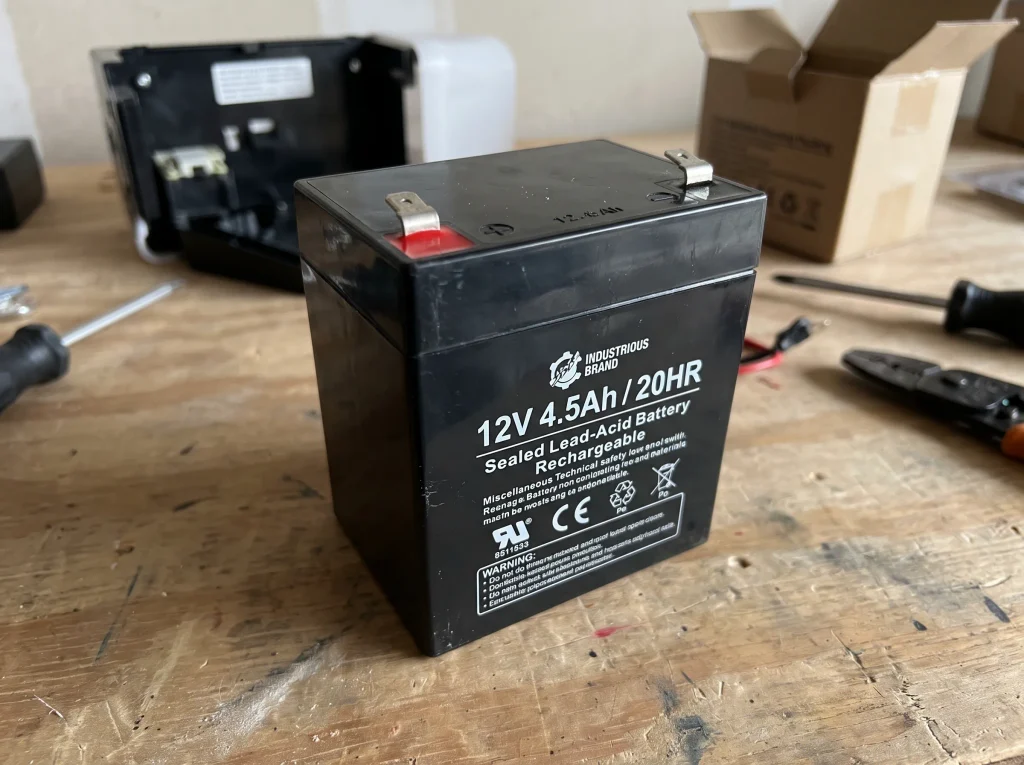
Choosing the right battery: Find the model number on the label on the motor unit, then match it to the battery listed in your owner’s manual. Chamberlain’s battery backup models use a 12-volt rechargeable battery rated at 4.5 amp-hours. Genie’s battery depends on the opener, and its higher-powered 140V openers need a larger battery than its 24V models. Genie also advises against using any battery it doesn’t supply. We explain why the right garage door repair parts matter in more detail, and Chamberlain owners can find replacement batteries and model instructions on Chamberlain’s official website.
How to do it:
- Close the garage door.
- Unplug the opener. Genie’s instructions call for disconnecting power before removing the motor cover, and it’s good practice on any brand.
- Set up a sturdy ladder under the motor unit.
- Open the battery compartment and take a photo of how the wires connect to the old battery.
- Disconnect the wires and remove the old battery.
- Install the new battery, reconnect the wires to match your photo, and close the compartment.
- Plug the opener back in. The battery light should flash green while the new battery charges.
Don’t want to climb the ladder? Our garage door opener service includes battery replacement and a full check of the opener while we’re there.
Call a pro if: you’d have to remove the motor cover to reach the battery, the wires or terminals are corroded or damaged, or the old battery is swollen, cracked, or leaking. Don’t handle a leaking battery with bare hands.
Step 5: Test the New Battery and Recycle the Old One
How to test a garage door opener battery backup after replacing it
What to look for: A solid green battery light, which means the new battery is fully charged.
How to do it:
- Let the battery charge until the light turns solid green.
- Unplug the opener and run the door through one full cycle from the wall button. Beeping about every 2 seconds is normal here, since that’s the opener telling you it’s on battery power. Then plug it back in.
- Run a safety reversal check. Our guide shows how to test your garage door’s safety features at home.
- Set a reminder to test the battery every 6 months, as Genie recommends. Genie owners can look up their exact replacement battery on Genie’s official store and support site.
- Recycle the old battery. Opener backup batteries are sealed lead-acid batteries, and lead-acid batteries shouldn’t go in the trash or your curbside recycling bin. Greene County Environmental Services at 2145 Greene Way Blvd. in Xenia accepts batteries. Call (937) 562-5925 to confirm drop-off hours.
Call a pro if: the door won’t run on battery after a full charge, or new batteries keep dying within months. On an older opener, repeated battery failures can point to a charging problem that makes garage door opener replacement the better investment.
DIY or Call a Pro? Low Battery Beeping at a Glance
Which garage door opener battery problems can you fix yourself?
| What you see or hear | What it means | DIY-safe fix | Call a pro when |
| Beep every 30 seconds, flashing orange light | Backup battery is low | Check the outlet, then replace the battery | A new battery doesn’t stop the beeping |
| Solid red light, beep every 30 seconds, power on | Battery can’t recharge | Replace the battery with the manual’s part | The light stays red with a new battery |
| Solid orange light, beep every 2 seconds | Opener is running on battery power | Check house power, the GFCI, and the breaker | Power is on but the opener stays on battery |
| Beeping and flashing lights right before the door closes | Timer or app warning, not the battery | See Why Does My Garage Door Beep Before It Closes? 4 Reasons | The door closes on its own with no setting behind it |
| Chirp every 30 to 60 seconds, opener light is green | Smoke alarm, CO alarm, or another device | Replace that device’s battery | Three or four loud beeps: get out and call 911 |
| Battery is swollen, cracked, leaking, or hot | Damaged battery | Unplug the opener and leave the battery alone | Always |
| Battery is inside the main motor housing | Harder access with more risk | None | Always |
A battery swap is one of the most homeowner-friendly opener jobs. Springs are the opposite, and our breakdown of garage door spring replacement: DIY vs. hiring a pro explains why.
Thinking about adding a battery backup to a very old opener? Check its age first. Every residential opener manufactured for sale in the U.S. since January 1, 1993 has to meet the federal entrapment protection standard, 16 CFR Part 1211, which you can read in full through Cornell Law School’s Legal Information Institute. If your opener predates that standard, a garage door opener installation with built-in battery backup gets you outage protection and current safety features at the same time.
Keep Your Backup Ready for the Next Outage
Garage door opener battery help in Xenia, OH
Most 30-second beeping ends with a fresh battery and a few minutes on a ladder. The best time to deal with it is before you need it: test your battery before storm season and again before winter, and keep AES Ohio’s website handy for outage updates when Greene County weather knocks the power out.
If the beeping won’t stop, the battery won’t charge, or you’d rather have a technician handle it, Dodson Garage Door can get your backup working again. Contact our team to book your battery replacement today.
Frequently Asked Questions
Can I stop the beeping without replacing the battery today?
Yes. Unplug the opener, disconnect the backup battery, and plug the opener back in. The beeping stops and the door runs normally on wall power. You won't have outage protection, though, so our rule of thumb from the field is to order the replacement the same day.
How do I know which backup battery my opener needs?
Find the model number on the label on the motor unit, then check your owner's manual or the manufacturer's parts listing. Most Chamberlain battery backup models use a 12-volt, 4.5 amp-hour rechargeable battery, while Genie's battery depends on the opener's motor type. If you're unsure, bring the old battery with you when you shop.
Can I use a generic battery instead of the brand-name one?
Genie recommends against using any battery it doesn't supply, and we stick to the manufacturer's listed part on our service calls. In our experience, off-brand batteries with the right voltage can still have different terminals or dimensions, so check the fit carefully if you go that route.
Why is my opener still beeping after I replaced the battery?
Give it time first, since the light flashes green while the new battery charges. If the beeping continues, check that the wires are on the right terminals and that the outlet has power. If the battery is correct, connected, and powered but the light stays red or orange, the opener's charging circuit may be the problem.
Does cold weather make a garage door opener battery beep?
It can. Backup battery ratings are based on room temperature, and cold reduces how much power a battery can deliver. In our experience, a battery that's already weak often triggers its warning during the first cold snap of the season, which is why many Xenia homeowners first hear it in late fall.
Will my garage door still work if I disconnect the backup battery?
Yes. The opener runs on wall power, so the door opens and closes normally. The only thing you lose is the ability to run the door during an outage without using the emergency release cord.
How many times can my door open and close on the backup battery?
It depends on the opener. A fully charged Chamberlain backup is designed for 24 hours of standby and up to 20 full cycles at room temperature. Genie says the integrated battery on its SilentMax LED Connect opener handles up to 50 cycles after a power failure. A cold garage or an aging battery will give you fewer.
How much does it cost to replace a garage door opener backup battery?
The battery itself is usually a modest parts cost, and most homeowners can install it themselves. Having a technician do it adds a service call, which makes sense when the battery is hard to reach or the opener has other issues. We'll quote the price before starting any work.
Is it safe to change a garage door opener backup battery myself?
For most openers, yes. Close the door, unplug the opener, and use a sturdy ladder. Stop and call a pro if the battery is swollen, leaking, or hot, or if you'd have to take the motor cover off to reach it. Never touch the springs or cables while you're up there.