

Yes, and more than the labor does. Two technicians can perform the same repair on the same door, and one fix lasts a decade while the other fails inside eighteen months. The difference is almost always the part that went in. Garage door components are sold in wide quality tiers: springs are rated by cycle count, rollers by bearing type, opener gears by material. A builder-grade part costs a few dollars less and fails several times sooner. When you approve a repair quote, you are approving a lifespan, so the specification matters more than the price.
Key takeaways
- Springs are rated in cycles, not years. A 10,000 cycle spring and a 25,000 cycle spring look identical hanging on the shaft.
- Rollers are the cheapest upgrade with the biggest daily payoff, mostly in noise and wear on everything else.
- Plastic opener gears are a wear item by design, not a defect. What matters is the kit you replace them with.
- Aftermarket is not automatically worse. Unrated is worse. Ask for the specification, not the brand.
- Springs, cables, and anything under tension are not DIY. The rest of this list mostly is.
- A quote that will not itemize parts is a quote you cannot compare against another one.
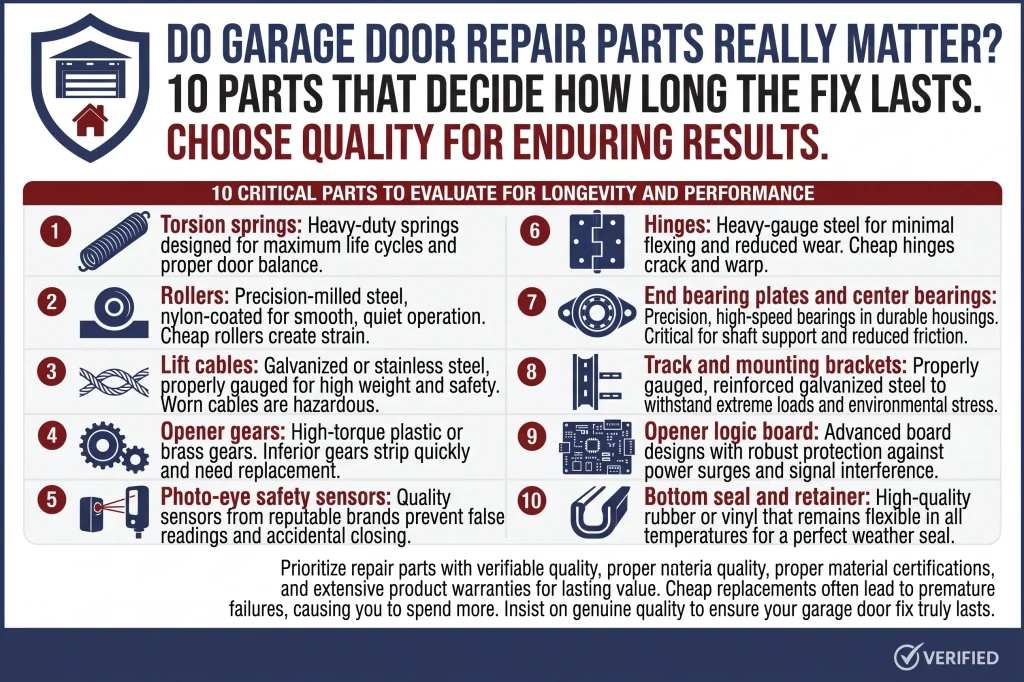
1. Torsion springs
Why garage door spring cycle rating matters more than brand
A spring that breaks after four or five years was almost certainly under-rated for the door it was lifting. Springs are rated by cycles, where one cycle is one full open and one full close. Standard builder springs are commonly rated around 10,000 cycles. If your household opens the door four times a day, that is roughly seven years. A high-cycle spring rated at 25,000 cycles or more, on the same door and same daily use, moves that horizon out past two decades.
The fix is to specify the rating when you approve the repair. Ask what cycle count is going on the shaft and what the wire size, inside diameter, and length are. A technician who cannot answer that is installing whatever was on the truck. Also insist that both springs be replaced together on a two-spring door, because the surviving spring has the same fatigue history as the one that just broke.
Call a pro if the door has any spring work at all. This is the one category on this list with no safe DIY path. Torsion springs hold enough stored energy to cause serious injury, and winding bars are not a substitute for experience. If a spring has already broken, our existing guides on whether a broken garage door spring is safe to use and how to manually open a door with a broken spring cover what to do before the truck arrives. For a fuller breakdown of the tradeoff, see garage door springs replacement, DIY vs hire a pro.
Commercial and warehouse doors compound the problem, because a dock door can burn through a residential cycle rating in a single quarter. That is why broken garage door spring repair on a commercial building is specified differently from the start.
2. Rollers
Why garage door roller quality changes how the whole door runs
If your door sounds like it is grinding its way up the track, the rollers are the first thing to look at. Builder-grade steel rollers ship with unsealed bearings, which means grit works into them from the first month. Once a roller stops rolling and starts dragging, it wears the track, loads the hinges, and makes the opener work harder for the same trip.
The fix is a full set replacement, not a one-off. Rollers wear at the same rate, so swapping the single loud one just moves the noise. Sealed-bearing nylon is the usual upgrade, though it is not a universal answer, and the tradeoffs are worth understanding before you buy. We covered them in Are Nylon Garage Door Rollers Better Than Steel? 7 Differences That Actually Matter.
Call a pro if the roller you want to change is the bottom one. The bottom roller sits in the bottom bracket, and the bottom bracket is attached to the lift cable, which is under full spring tension. The middle and top rollers are approachable for a careful homeowner. The bottom one is not.
3. Lift cables
Why garage door cable gauge and drum matching matter
Fraying at the bottom bracket, a door that hangs crooked, or a cable that has jumped off the drum all point to the same category. Cables fail from abrasion and from mismatch, and the mismatch part is what gets missed. Cable diameter has to suit the door weight, and the drum has to suit the door height. Put a standard 7-foot drum on a taller door and the cable stacks wrong on the drum every single cycle.
The fix is replacement in pairs with the correct gauge, plus an inspection of what shredded the old one. A cable rarely dies of old age. Something abraded it: a rough drum edge, a misaligned bottom bracket, or a roller that seized and pulled the door out of square.
Call a pro. Cables are under the same tension as the springs and belong in the same category. If yours failed alongside other symptoms, signs your garage door springs need replacement is worth a read, because the two systems fail together more often than separately.
4. Opener gears
Why garage door opener gear material determines the repair interval
A motor that hums or grinds while the door does not move is the classic stripped-gear symptom. Most chain and screw drive openers use a nylon drive gear that is meant to be the sacrificial part, protecting the more expensive motor and board. That design is sound. The problem is that replacement kits vary enormously in material quality and in whether they include the worm gear and bearings or just the drive gear alone.
The fix is a complete kit with fresh lubricant, not a bare gear. And before you rebuild, check whether the gear stripped because of something else, such as a binding door forcing the opener to pull far more weight than it should. Replacing gears on a door that is dragging just schedules the next failure. The full breakdown lives in Why Do Garage Door Opener Gears Strip? 6 Causes and What to Replace Them With.
Call a pro if the opener is more than fifteen years old or if the housing has to come down to do the work. At that age, the rebuild cost starts approaching a new unit with a current safety and encryption standard.
5. Photo-eye safety sensors
Why garage door sensor quality affects safety, not just convenience
A door that reverses for no reason, or that will only close when you hold the wall button, is usually a sensor problem. Federal safety requirements have mandated an entrapment protection system on residential openers since 1993, and the photo eyes are that system. Cheap universal sensors are the one substitution on this list we would push back on hardest, because a sensor that reads inconsistently in bright afternoon sun is a sensor that fails when a child is in the opening.
The fix is matched sensors from the opener manufacturer, mounted no higher than six inches off the floor, aligned until both indicator lights are steady. Loose brackets are a more common cause than dead sensors, so check alignment before you buy anything.
Call a pro if the lights stay correct and the door still reverses, because the fault has moved upstream to the logic board or the wiring. Our guides on testing your garage door safety features at home and garage door safety warning signs walk through the monthly checks that catch this early.
6. Hinges
Why garage door hinge gauge matters on heavy insulated doors
Cracked hinge plates, elongated screw holes, or a visible gap between sections when the door is midway through its travel all point to hinges. They are stamped steel, they are numbered by position, and they are frequently under-specified. A heavier insulated door needs a heavier gauge than the one a builder used on a basic single-layer door.
The fix is replacement with the correct numbered hinge for that position, using the original fastener size or one step larger if the holes have wallowed out. Work on a fully closed door so no section is carrying load.
Call a pro if the section itself is cracked around the hinge, not just the hinge. At that point you are looking at section replacement, and the math on repairing versus replacing changes. How to fix common garage door safety issues covers the inspection steps.
7. End bearing plates and center bearings
Why worn garage door bearings destroy more expensive parts
A rhythmic squeal that tracks with door movement, or black dust below the spring anchor, means a bearing is going. These are inexpensive parts, and that is exactly why they get skipped during a spring job. Skipping them is a false economy. A dry or seized bearing puts side load on the torsion shaft, and a scored shaft is a far larger repair than the bearing that scored it.
The fix is to replace bearings whenever the springs come off, since the shaft is already coming down and the labor is effectively free at that point. Ask for it explicitly on the quote, because it is a line item that quietly disappears from cheaper bids.
Call a pro. Bearings sit on the tensioned shaft assembly, so this is spring-adjacent work.
8. Track and mounting brackets
Why garage door track gauge and bracket quality prevent repeat failures
Dents, separated track joints, or a door that binds at one specific point in its travel are the signs here. Light-gauge track deforms under load and then holds that deformation, so the door catches in the same spot forever. Track is also frequently damaged in a way that looks cosmetic and is not.
The fix is replacement of the affected section with matching gauge and radius, then a full realignment. Do not straighten dented track and call it done, because the metal has already yielded. We have covered the symptom side in depth in garage door off track: top causes and fixes and garage door off track warning signs.
Call a pro if the door has already come off the track. It is not a stable object at that point, and our guidance on whether a garage door off track is safe to use and off track: DIY or call a pro explains why. Track and bracket specification is also decided at install time, which is why a properly scoped garage door installation prevents years of recurring alignment calls.
9. Opener logic board
Why garage door opener circuit board replacement is often the wrong call
Intermittent operation, a unit that responds to the wall button but not the remote, or one that runs only after a power cycle, tends to get diagnosed as a bad board. Sometimes it is. Often it is a failing capacitor, a bad limit switch, or moisture in a connector, and the board gets swapped because swapping is faster than testing.
The fix is a real diagnosis first. If the board genuinely is faulty, the manufacturer board is worth the premium here, because generic boards frequently drop the rolling-code security implementation that keeps someone from cloning your remote in the driveway.
Call a pro before authorizing a board swap on any opener that is a decade or older. A new board on an aging chassis is often most of the cost of a new opener without any of the warranty. This is the same calculation described in 5 signs you should replace your garage door, applied to the opener instead of the door.
10. Bottom seal and retainer
Why the garage door bottom seal retainer matters more than the seal
Daylight under a closed door, water tracking into the garage, or a seal that keeps sliding out of its channel are the common complaints. Almost everyone replaces the rubber and leaves the aluminum retainer in place. If that retainer is bent, corroded, or the wrong profile for the seal being fitted, the new seal will walk right back out.
The fix is to match the seal profile to the retainer, T-style to T-style and bead to bead, and to replace the retainer itself if the channel has spread. Cold weather matters too, since vinyl stiffens and shrinks while EPDM rubber stays flexible. The whole decision is laid out in Why Does My Garage Door Bottom Seal Keep Coming Off? 7 Reasons and How to Pick the Right One.
Call a pro if the bottom section is rusted through where the retainer mounts, because there is nothing left to hold a fastener. That is a section or garage door replacement conversation rather than a seal one.
What you can do yourself and what needs a technician
DIY-safe garage door parts vs parts that require a professional
| Part | Safe to DIY? | Why |
| Torsion springs | No | Stored energy causes serious injury. Specialized winding tools required. |
| Lift cables | No | Under full spring tension at all times. |
| End and center bearings | No | Mounted on the tensioned shaft assembly. |
| Bottom roller | No | Attached to the cable via the bottom bracket. |
| Middle and top rollers | Yes, with care | No tension load. Work with the door fully closed. |
| Hinges | Yes, with care | Replace one at a time on a closed door. |
| Photo-eye sensors | Yes | Low voltage. Alignment is most of the job. |
| Bottom seal and retainer | Yes | No tension involved. Sizing is the hard part. |
| Opener gear kit | Sometimes | Doable on newer units. Aging openers usually favor replacement. |
| Logic board | No | Diagnose before replacing. Security implementation matters. |
| Track and brackets | No | Requires realignment against the spring system. |
How to make sure you are getting the right parts
Questions to ask before approving a garage door repair quote
Ask for the specification in writing. On springs that means cycle rating, wire size, inside diameter, and length. On rollers it means bearing count and whether they are sealed. On an opener repair it means whether the part is manufacturer or aftermarket, and what the warranty covers on parts separately from labor.
Be cautious about anyone who quotes a suspiciously low number over the phone and then discovers additional problems on arrival. The industry has been vocal about this pattern. The International Door Association publishes guidance for homeowners, and its scam awareness resources are worth reading before you book anything. Manufacturer Clopay maintains a parallel guide on how to avoid garage door scams that covers the same warning signs from the product side.
The same principle applies on the commercial side, where downtime costs more than the part ever will. A properly specified garage door repair on a loading dock is scoped around duty cycle rather than around the lowest bid.
The bottom line on garage door repair parts
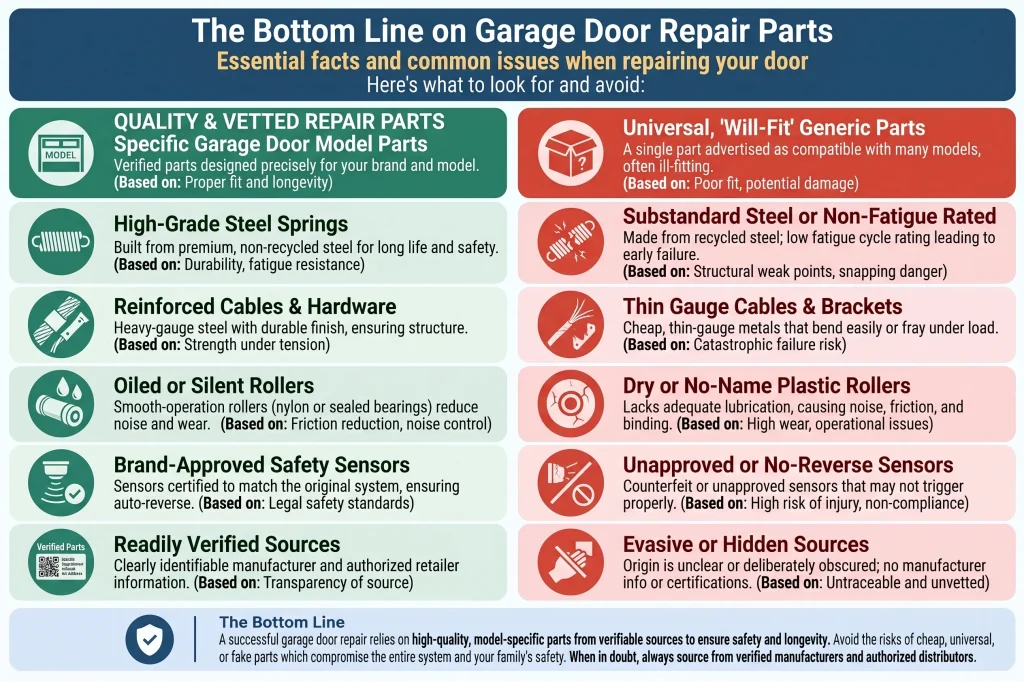
Why specifying parts up front saves money over the life of the door
The cheapest repair and the best repair are almost never the same repair, and the gap between them shows up two winters later rather than on the invoice. Ask what is going on the door, ask what it is rated for, and get it in writing. A repair specified correctly the first time is the one you stop thinking about.
Serving Dayton, Beavercreek, Centerville, Fairborn, Bellbrook, Cedarville, and Jamestown, Dodson Garage Door itemizes parts on every quote so you can see exactly what you are approving.
Need a repair done with parts rated for your door? Request a free quote and same-day service.
Frequently asked questions
2. Are aftermarket garage door parts always worse than manufacturer parts?
No, and this is a common misunderstanding. Plenty of aftermarket springs, rollers, and hardware meet or beat manufacturer specification. The distinction that matters is rated versus unrated. A part with a published cycle rating or bearing specification can be compared. An unbranded part with no published numbers cannot, and that is where the risk sits. The exceptions where we do lean manufacturer are safety sensors and opener logic boards.
3. Why did my garage door spring break after only a few years?
Almost always because the cycle rating did not match the household. Springs do not fail on a calendar, they fail on a count. A family with two drivers and teenagers can run four times the cycles of a single-occupant home on the same door, and a spring rated for the second household will not survive in the first.
4. My opener still runs but the door will not move. Is that expensive?
That is one of our most common calls, and it is usually the least expensive outcome on the list. A motor that hums or grinds without moving the door typically means the drive gear has stripped, which is the part designed to fail first. It protects the motor. The rebuild is generally a modest parts cost plus an hour of labor, well under the cost of a new opener.
5. Should I repair or replace an opener that is fifteen years old?
Our rule of thumb from the field is that once the repair reaches roughly half the cost of a new unit on a door that old, replacement wins. Older openers also predate current rolling-code security and current safety standards, so a replacement buys improvements a repair cannot.
6. Can I replace just the one roller that is making noise?
You can, and it will be quiet for a few weeks. Rollers wear together because they have done identical work, so the noise simply migrates to the next one. We replace them as a set for that reason. The exception is the bottom roller, which is attached to the cable under tension and is not a homeowner job regardless.
7. My door reverses right before it closes. Is that a sensor or something worse?
Start with the sensors, because loose or misaligned photo eyes account for most of these calls, and the fix is often free. If both indicator lights are steady and clean and the door still reverses, the cause has usually moved to the close-limit setting or the door binding physically in the track. That second one needs an inspection.
8. What should a garage door repair cost?
We give ranges rather than flat numbers because the part specification drives the price. A sensor alignment or a seal replacement sits at the low end, typically a service-call minimum. Spring replacement occupies the middle, and the spread within it comes from cycle rating rather than from labor. Opener replacement is the top of the range. Any company that quotes a firm price before seeing the door is quoting a starting point, not a total.
9. My door worked fine before the power went out and now the remote does nothing.
Check whether the opener lost its programming, which happens on some units after a surge. Reprogramming the remote takes a few minutes and costs nothing. If reprogramming will not take, a surge may have damaged the logic board, and that is worth a diagnosis before anyone sells you a replacement board.
10. The problem comes and goes. Is it worth calling if the door is working right now?
Yes, and intermittent faults are the ones we would rather see early. Doors do not heal. An intermittent symptom means something is marginal: a bearing beginning to seize, a cable starting to fray, a connection working loose. Every one of those is cheaper to address while the door still runs than after it stops with a car inside.