

Opener gears strip because the nylon drive gear is designed to be the part that fails first, protecting the motor and the circuit board behind it. When you hear the motor hum or grind while the door sits still, that gear has usually given up. The important question is not how to replace it but why it stripped. In most cases the gear was the victim rather than the cause: a door out of balance, a binding track, or a broken spring forced the opener to lift far more weight than it was built for. Replace the gear without fixing that, and the new one strips too.
Key takeaways
- A motor that runs while the door stays put is the classic stripped-gear symptom, and it is usually a modest repair.
- The nylon gear is sacrificial by design. It failing is the system working, not a defect.
- The most common underlying cause is a door the opener should never have been lifting alone: worn or broken springs.
- Never run the opener on a door with a broken spring. That is the fastest way to destroy a gear set.
- Buy the full kit, not a bare gear. The worm gear, bearings, and correct grease all matter.
- All-metal gear conversions sound like an upgrade and usually are not. They remove the part that protects the motor.
- On an opener past about fifteen years, the rebuild often costs most of what a new unit does.
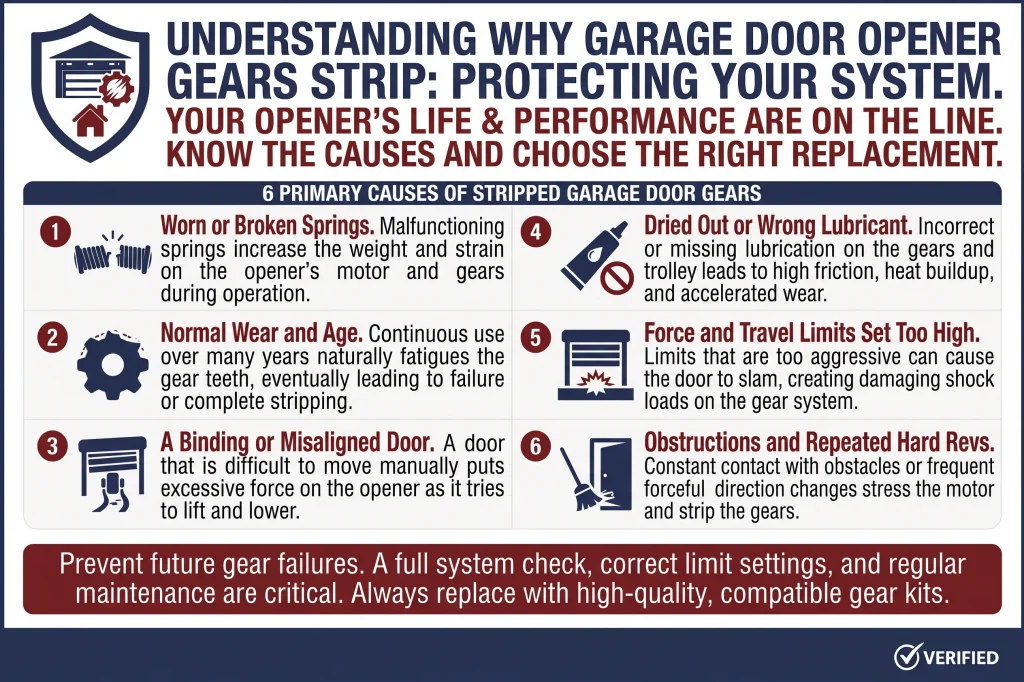
1. Worn or broken springs
Why bad garage door springs strip opener gears
This is the cause we find most often, and it is the one homeowners least expect. A garage door opener is not built to lift a door. Torsion springs carry the weight, and the opener only supplies the small push needed to get a balanced door moving. When springs weaken or break, that balance disappears and the opener suddenly finds itself hauling well over a hundred pounds of dead weight through a nylon gear.
The gear will do it for a little while. Then it rounds off its teeth and the motor spins free.
Test the balance yourself before you order any parts. Pull the emergency release cord, lift the door by hand to about waist height, and let go. A properly balanced door stays roughly where you put it. If it slams down or rockets up, the springs are the problem and the gear was collateral damage. Our guide to signs your garage door springs need replacement covers the rest of the symptoms.
Call a pro for anything spring related. Torsion springs store enough energy to cause serious injury and are not a homeowner repair, as garage door springs replacement, DIY vs hire a pro explains in detail. If a spring has already broken, stop using the opener entirely. Is a broken garage door spring safe to use explains why, and how to manually open a door with a broken spring covers getting the car out in the meantime. On a commercial building, a fast broken garage door spring repair is usually cheaper than the opener damage that follows a few days of running on bad springs.
2. Normal wear and age
How long garage door opener gears last before they strip
Sometimes nothing is wrong except the calendar. The drive gear is a wear item, and on a chain or screw drive unit that has run several times a day for a decade or more, teeth simply round off from use.
You can usually tell this apart from the other causes by how it arrived. Age-related failure comes on gradually: the opener gets noisier over months, occasionally slips, then finally spins free. Damage-driven failure is abrupt, often on a specific cycle, and there is usually another symptom alongside it.
The fix here is straightforward, and it is one of the more satisfying repairs because the door works again for a fraction of a replacement cost. Just verify the balance first anyway. Age and bad springs often arrive together, since both are counting the same cycles. Gear wear is part of the same story told in Do Garage Door Repair Parts Really Matter? 10 Parts That Decide How Long the Fix Lasts, where component specification decides how long any given repair holds.
3. A binding or misaligned door
How worn rollers and bad track cause opener gears to strip
If the door catches at one specific point in its travel, the opener has to surge through that spot on every cycle. That surge lands on the gear teeth. Seized rollers, a bent track section, or a door that has drifted out of square all produce the same result.
The tell is location. A door that struggles at the same height every time has a mechanical obstruction, not a tired motor. Run the door up and down by hand with the opener disengaged and feel for the catch.
Worn rollers are the usual culprit and the cheapest to address, though the material and bearing choice matters more than most people realize. We covered that in Are Nylon Garage Door Rollers Better Than Steel? 7 Differences That Actually Matter. If the track itself is the problem, garage door off track: top causes and fixes and garage door off track warning signs cover diagnosis, and off track: DIY or call a pro covers where to stop.
Stop using the opener if the door has come off the track. Powering a door that is not properly captured in its track is how a bad situation becomes an expensive one, and is a garage door off track safe to use explains the risk.
4. Dried out or wrong lubricant
Why the wrong grease on opener gears causes premature stripping
The drive gear and worm gear run in grease, and that grease has a service life. Once it dries or migrates off the teeth, nylon runs against steel with nothing between them, and the nylon loses.
The wrong lubricant does the same damage faster. Household spray lubricants and general purpose oils are too thin for a gear set. They wash the remaining grease off the teeth and then evaporate, which leaves the gear worse off than doing nothing. Use a white lithium grease intended for opener gears, or whatever the manufacturer specifies for that unit.
A related point: greasing the rail is not the same job as greasing the gears. Rail lubrication is routine maintenance you can do from a ladder. The gear grease lives inside the motor housing and only gets replaced when the housing is opened, which is why fresh grease is part of any proper gear kit installation.
If you are already doing a maintenance pass, run through how to test your garage door safety features at home while you are up there.
5. Force and travel limits set too high
How incorrect opener force settings destroy gears
Every opener has force and travel limit adjustments. Force controls how hard the unit pushes before it decides something is wrong and reverses. Travel controls where it stops.
When a door starts getting hard to move, the instinct is to turn the force up until it works again. That instinct is understandable and it is the wrong move twice over. It masks the mechanical problem that needs fixing, and it commands the gear to deliver more torque than it was designed to transmit. Turning up the force on a door with failing springs is close to a guaranteed gear failure.
Travel limits matter too. If the down limit is set past the floor, the opener drives the door into the concrete on every close and the gear absorbs the impact each time.
The correct approach is to set force at the lowest setting that reliably operates a properly balanced door, then leave it alone. If the door needs more force than that, something mechanical needs attention. How to fix common garage door safety issues covers the safety implications, and they are real: force settings exist for entrapment protection, not convenience.
6. Obstructions and repeated hard reversals
How obstructions and a stuck door strip garage door opener gears
Every time the door hits something and reverses, the gear takes a shock load. One or two is nothing. A pattern of them adds up.
The obstruction is not always an object in the opening. In the Dayton area we see doors freeze to the concrete overnight in winter, usually because the bottom seal has collected water that then turns to ice. The opener tries to lift a door that is physically bonded to the floor, the gear absorbs the full stall, and by February it is stripped. A seal that seats properly and sheds water prevents most of that, which is one of the practical reasons behind Why Does My Garage Door Bottom Seal Keep Coming Off? 7 Reasons and How to Pick the Right One.
Misaligned photo eyes create a similar pattern, with the door reversing repeatedly while someone holds the button to force it down. Each of those is a shock cycle. Garage door safety warning signs covers what those reversals are actually telling you.
If the door is frozen down, do not hold the button. Break the ice loose first, or disengage the opener and lift by hand.
What to replace stripped opener gears with
Choosing a garage door opener gear kit that actually lasts
Buy a kit, not a gear. A proper kit includes the drive gear, the worm gear, the bearings, the sprocket where applicable, and the correct grease. Replacing only the visibly stripped part leaves worn mating surfaces in place, and worn surfaces chew up a new gear quickly.
| Option | What it is | Verdict |
| Manufacturer gear kit | Complete kit from the opener maker | Best choice for most units. Correct tolerances, correct grease, fits without modification. |
| Quality aftermarket kit | Complete kit from a reputable parts supplier | Fine, and often less expensive. Confirm it lists the worm gear and bearings, not just the drive gear. |
| Bare drive gear | Single gear, no worm gear or bearings | Skip it. Cheapest up front and the shortest-lived repair on this list. |
| All-metal gear conversion | Aftermarket steel replacement for the nylon gear | Not recommended for residential. Removes the sacrificial part, so the next overload goes into the motor or the board instead. Louder as well. |
| New opener | Complete replacement unit | The right call on units past roughly fifteen years, or where the rebuild approaches half the cost of new. |
The all-metal option deserves the extra warning because it is marketed as a permanent fix. It is not. Nylon fails first on purpose, and the gear is by far the cheapest thing in that chain to replace.
Be equally cautious about the opposite pitch: a technician who inspects a stripped gear and quotes a full opener replacement without discussing the rebuild. That is a legitimate recommendation on an aging unit and a red flag on a newer one. The International Door Association publishes homeowner guidance on this pattern, and its advice on recognizing garage door repair scams is worth a read before approving work. Clopay makes the same point from the manufacturer side in its guide to spotting dishonest garage door contractors.
Repair or replace the opener
When a stripped gear means it is time for a new garage door opener
Rebuild the gear set when the opener is under roughly ten to twelve years old, the housing and rail are in good condition, and the door itself is sound. That repair is inexpensive relative to a new unit and buys years.
Replace the opener when it is past about fifteen years, when the motor or board has also been damaged, or when the rebuild cost approaches half the price of a new unit. Older openers also predate current rolling-code security and current safety standards, so replacement buys improvements a repair cannot.
Call a technician before authorizing either one if the door is also showing symptoms. An opener is the wrong thing to spend money on when the actual problem is the door, and that diagnosis is worth an hour of someone’s time. If the door itself is aging out, 5 signs you should replace your garage door is the better starting point, and pairing a new opener with a garage door installation lets both be specified to match instead of retrofitted later.
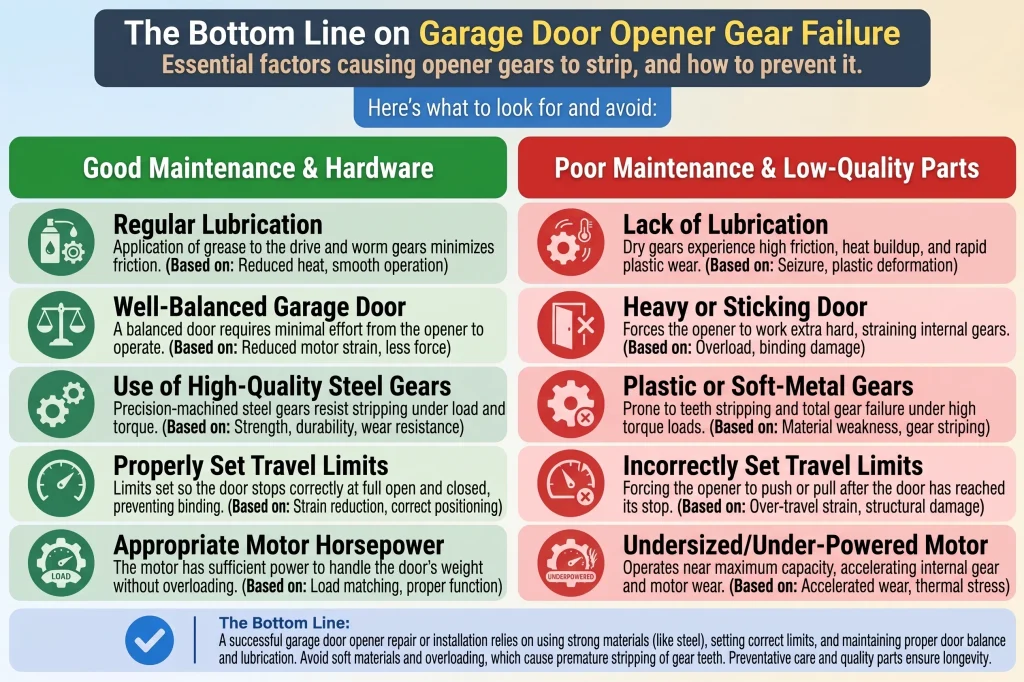
The bottom line on stripped opener gears
What to check before you replace a garage door opener gear
A stripped gear is usually cheap to fix and almost always a symptom of something else. Do the balance test first. If the door does not hold its position by hand, the springs caused this and the gear is the second repair, not the first. If the balance is good and the door moves freely by hand, the gear was simply old, and a complete kit will put you back in service for a modest cost.
Serving Dayton, Beavercreek, Centerville, Fairborn, Bellbrook, Cedarville, and Jamestown, Dodson Garage Door diagnoses the door before quoting the opener, whether the job is a residential gear rebuild, a commercial garage door repair, or a full garage door replacement.
Opener humming but the door will not budge? Request a free quote and same-day service.
Frequently asked questions
2. How much does a gear replacement cost compared to a new opener?
We quote ranges rather than flat numbers, but the shape of it is consistent: a gear kit rebuild is a modest parts cost plus about an hour of labor, and it typically lands well under half the price of a new installed opener. That gap is what makes the repair worth doing on a unit that still has life in it.
3. Can I replace the gears myself?
On a newer unit with the housing accessible, a mechanically confident homeowner can do it. The job involves dropping the cover, removing the old gear and worm gear, cleaning out the old grease thoroughly, and reassembling with new grease. Where people get into trouble is skipping the cleanout or leaving the worn worm gear in place. And if the opener has to come down off the ceiling to do the work, the math usually favors calling someone.
4. Why did my gears strip again after only a year?
Because the underlying cause is still there, and this is the pattern we see most often on repeat visits. In our experience the answer is almost always door balance. If nobody checked the springs during the first repair, the new gear inherited exactly the same overload that killed the first one.
5. Are metal replacement gears better than nylon?
No, and we would steer you away from them on a residential opener. The nylon gear is engineered to fail before the motor does. Replace it with steel and the next overload has to go somewhere, which means the motor or the logic board, both of which cost considerably more. They also run louder.
6. How do I know if my springs are the real problem?
Pull the release cord, lift the door by hand to about waist height, and let go. A balanced door stays put. If it drops or flies up, the springs are not carrying the weight and the opener has been doing their job. That test takes thirty seconds and it is the single most useful thing you can do before calling anyone.
7. How long should a garage door opener last?
Our rule of thumb from the field is ten to fifteen years for a residential unit under normal use, with the gear set often needing attention somewhere in the middle of that. Openers on doors that are well maintained and properly balanced routinely beat that range. Openers fighting a heavy door do not.
8. The opener worked fine and then failed suddenly with a grinding noise. What happened?
Sudden failure with grinding usually means something changed mechanically rather than gradually. A spring breaking is the classic version: the door doubles in effective weight in an instant, and the gear goes on the next cycle. Check the springs visually for a gap in the coil before anything else.
9. Should I lubricate my opener gears as maintenance?
Not as a routine homeowner task, because the gear grease sits inside the sealed motor housing and opening it up is not a casual job. What you should do routinely is lubricate the rail and the door hardware, which is a different job and does prevent a real share of the strain that reaches the gear.
10. Is it safe to keep using the opener until I can get it repaired?
We would rather you did not. If the gear is partially stripped, the door can stop unexpectedly partway through its travel, and a door stopped in an unknown state is not something to park under. Disengage the opener with the release cord and operate the door manually until it is repaired. If the door is too heavy to lift by hand, that confirms the spring problem and the door should not be used at all until someone looks at it.