

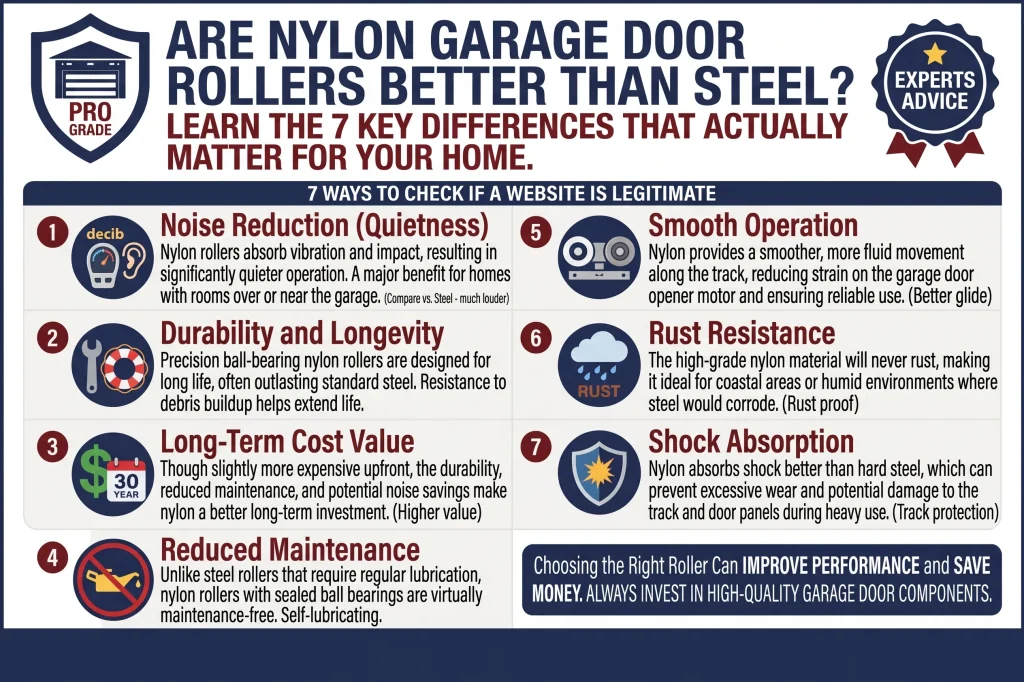
For most homes, yes. Nylon rollers with sealed ball bearings run dramatically quieter, last two to three times longer, and put less wear on the track and opener than the builder-grade steel rollers that ship on new doors. Steel still wins in two situations: very heavy doors and high-cycle commercial applications, where load capacity matters more than noise. The comparison that actually decides it is not nylon against steel. It is sealed bearings against unsealed ones, and that distinction cuts across both materials.
Key takeaways
- The bearing matters more than the wheel. A sealed-bearing roller outlasts an unsealed one regardless of what the wheel is made from.
- Nylon is quieter because the wheel never makes metal-on-metal contact with the steel track.
- Builder-grade steel rollers are the single most commonly under-specified part on a new door.
- Steel is the right answer on heavy insulated doors, wide doubles, and commercial units under real duty cycles.
- Bearing count is the spec to ask for. More bearings spread the load and reduce play in the stem.
- Replace rollers as a full set. They wear at the same rate, so one at a time just moves the noise along.
- The bottom roller is not a DIY part on either material, because it sits in a bracket under full cable tension.
1. Noise
Why nylon garage door rollers are quieter than steel rollers
If the door wakes people upstairs, this difference alone settles the question. A steel wheel rolling inside a steel track is metal on metal, and every imperfection in the track transmits straight into the structure of the house. Nylon has enough give to absorb that, so the same door on the same track drops from a rumble to a hum.
The common mistake is treating a loud door as a lubrication problem. Grease quiets an unsealed bearing for a few weeks, then dust binds to it and the noise returns worse than before. If your door got loud again a month after someone sprayed it, the rollers were the problem, not the lubricant.
Worth knowing: noise is also a diagnostic. A grinding or popping sound that appears suddenly is not a roller wearing in, it is something failing. Our guide to garage door safety warning signs covers which noises mean stop using the door.
2. Lifespan
How long nylon garage door rollers last compared to steel
Rollers are rated in cycles, the same way springs are. Builder-grade steel rollers with unsealed bearings commonly carry ratings around 10,000 cycles, which on an average household comes out somewhere near seven years. Quality nylon rollers with sealed bearings are typically rated far higher, often in the 15,000 to 25,000 range and beyond for premium sets.
That gap exists almost entirely because of contamination. An unsealed bearing is open to the driveway: dust, road salt, grass clippings, and moisture all get in. Once the bearing is packed with grit, the wheel stops rotating and starts sliding, and a sliding roller wears its own flat spot within weeks.
The practical rule is to inspect rather than wait. Pull the door down manually and spin each wheel with a finger. Anything that resists, wobbles on its stem, or has visible flat spots is done. Roller wear rarely stays a roller problem, which is why it appears in Do Garage Door Repair Parts Really Matter? 10 Parts That Decide How Long the Fix Lasts alongside the other components that quietly determine how long a repair holds.
3. Bearings
Why sealed ball bearings matter more than the roller material
This is the difference most buyers miss, and it is the one we would put first if the marketing did not push material so hard. Rollers fall into three real tiers, and material is not what separates them.
The bottom tier is a solid wheel with no bearings at all, just a wheel spinning on a bare stem. These exist in both plastic and steel and they are the shortest-lived thing you can install. The middle tier is unsealed ball bearings, which is where most builder-grade steel rollers sit. The top tier is sealed ball bearings, most commonly paired with a nylon wheel.
Bearing count is the number to ask for. More bearings distribute the load across a wider surface, which reduces play in the stem and keeps the wheel tracking straight. When you request a quote, ask how many bearings per roller and whether they are sealed. A supplier who will not answer is selling the bottom tier.
Steel with sealed bearings is a real product and it is a good one. Nylon without bearings is also a real product and it is not. The material on the box tells you less than the bearing spec does.
4. Load capacity
When steel garage door rollers are the better choice
Steel wins on weight. On a heavy wood door, a wide double, or an insulated door at the top of its weight class, steel handles sustained load with less deformation than nylon does. The same is true anywhere the duty cycle is high, which is why commercial and warehouse doors are usually specified in steel from the start.
A residential door in normal use is nowhere near the limit of a quality nylon roller. The point at which the calculation flips is weight combined with frequency, not weight alone. A heavy door opened twice a day is fine on nylon. A moderate door opened forty times a day is not.
If you are unsure which side of that line your door falls on, weight is the thing to establish before buying anything. That is also part of what gets specified during a proper garage door installation, where roller selection is matched to door weight rather than to whatever came in the hardware kit.
5. Temperature and weather
How Ohio winters affect nylon and steel garage door rollers
Both materials have a weather weakness and they are opposite ones. Steel rusts. In a garage that sees road salt tracked in every winter, an unsealed steel bearing corrodes from the inside, and a rusted bearing seizes rather than degrades gracefully.
Cheap nylon has the opposite problem. Low-grade nylon becomes brittle in sustained cold and can crack, usually at the hub. Quality nylon formulated for this application does not, which is another reason the price gap between roller sets is not arbitrary.
For the Dayton area specifically, the combination of salted roads and a real freeze-thaw cycle argues for sealed bearings whichever wheel you choose. The seal is what keeps salt and moisture out of the part that actually fails.
6. Cost over the life of the door
Are nylon garage door rollers worth the extra money
Per roller, the price difference between builder-grade steel and quality sealed nylon is small, and a standard door takes ten to twelve rollers. Spread that across a set and it remains one of the least expensive upgrades available on a garage door.
The reason it pays back is not the rollers themselves. It is what worn rollers do to everything around them. A dragging roller loads the hinges, wears the track, and forces the opener to pull harder on every single cycle. Opener gears are designed to be the sacrificial part in that chain, and they strip earlier when the door is fighting the track. That relationship is covered in Why Do Garage Door Opener Gears Strip? 6 Causes and What to Replace Them With.
Be wary of anyone selling a roller upgrade as an emergency. A worn roller set is a maintenance item with weeks or months of warning, not a same-day crisis. High-pressure upselling on routine parts is one of the patterns the International Door Association has publicly flagged for homeowners, and its guidance on spotting garage door service scams is worth reading before you approve any work you did not go looking for.
7. Effect on the rest of the door
How worn garage door rollers cause track and opener problems
This is the difference that costs the most and gets noticed the least. Rollers are the interface between the door and the track, so when they fail, the failure propagates.
A seized roller drags instead of rolls, which pulls the door out of square and puts lateral pressure on the track. Given enough time, that is how a door comes off the track entirely. We covered the mechanism in garage door off track: top causes and fixes, and the early symptoms in garage door off track warning signs.
The same drag transfers into the opener as extra load on every cycle, and into the springs, which are already carrying the full weight of the door. If the door has started feeling heavier or moving unevenly, check signs your garage door springs need replacement as well, because roller and spring symptoms overlap more than people expect.
Stop using the door and call a technician if it has already jumped the track. Whether a garage door off track is safe to use explains why that is not a wait-until-Monday situation, and off track: DIY or call a pro covers where the line sits.
Nylon vs steel garage door rollers at a glance
Side by side comparison of nylon and steel garage door rollers
| Factor | Nylon (sealed bearing) | Steel (unsealed, builder grade) | Steel (sealed bearing) |
| Noise | Quietest. No metal-on-metal contact. | Loudest. Transmits into the house. | Moderate. Quieter than unsealed but still metal on track. |
| Typical cycle rating | High, commonly 15,000 and up | Low, commonly around 10,000 | High |
| Lubrication needed | None on the bearing | Frequent, and it stops working | None on the bearing |
| Contamination resistance | Sealed against dust and salt | Open to everything | Sealed |
| Heavy door capacity | Good for residential weights | Adequate | Best |
| High duty cycle | Good | Poor | Best |
| Cold weather | Fine if quality nylon. Cheap nylon can crack. | Prone to rust and seizing | Fine |
| Cost per set | Moderate | Lowest | Highest |
| Best for | Most homes, especially attached garages | Nothing, honestly. This is the default you should upgrade from. | Heavy doors, commercial, high-frequency use |
What you can replace yourself
Which garage door rollers are safe to change without a technician
Middle and top rollers are approachable for a careful homeowner. Work with the door fully closed so no section is under load, replace one roller at a time, and never remove more than one hinge at a time.
The bottom roller is different and the distinction is not negotiable. It sits in the bottom bracket, and the bottom bracket is attached to the lift cable, which carries the full tension of the spring system whenever the door is down. Removing that bracket without releasing tension first is how people get seriously hurt. The same reasoning behind garage door springs replacement, DIY vs hire a pro applies here exactly.
Call a technician if the stem will not come free, if the track is dented where the roller travels, or if the door binds at a specific point after you finish. Binding after a roller change usually means the track needs realignment, not another roller. While you have the door apart, it is a good moment to run through how to test your garage door safety features at home and how to fix common garage door safety issues.
One more thing to check while you are at the bottom of the door: the seal and its retainer sit in the same area, and a bent retainer is easy to spot once the door is open. Why Does My Garage Door Bottom Seal Keep Coming Off? 7 Reasons and How to Pick the Right One covers what to look for.
The bottom line on nylon vs steel rollers
Which garage door rollers to choose for your door
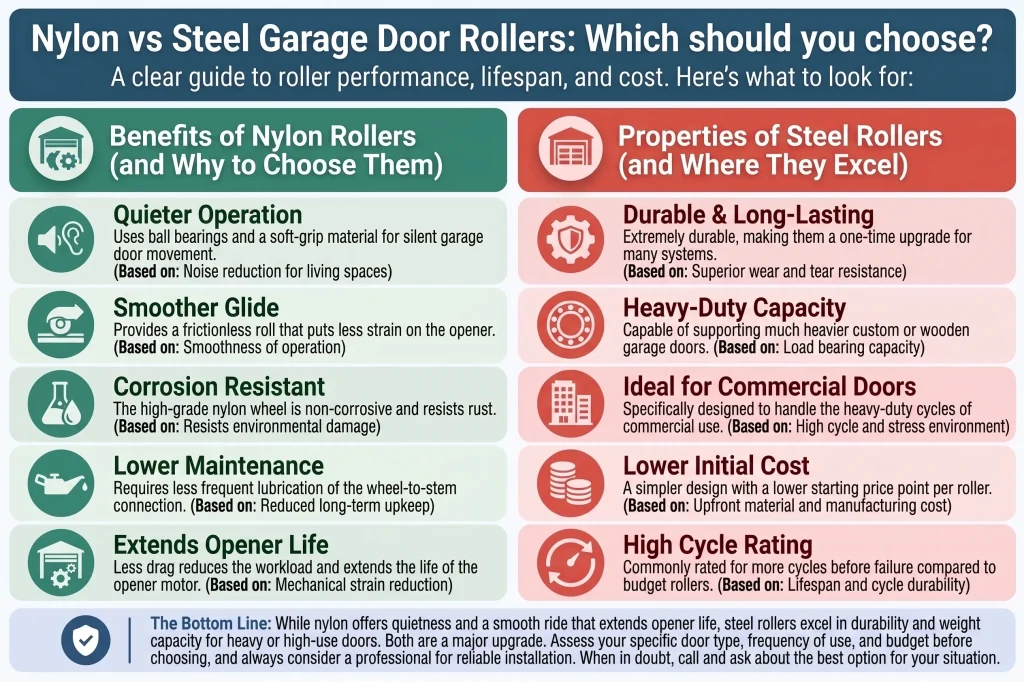
For a typical attached residential garage, sealed-bearing nylon is the better buy on almost every axis that matters day to day. For a heavy door, a wide double, or anything running a commercial duty cycle, sealed-bearing steel is the stronger choice. What nobody should be installing is an unsealed builder-grade roller, in either material, on a door they intend to keep.
When you ask for a quote, ask for the bearing count and whether the bearings are sealed, and get the answer in writing. A shop that will not put the specification on paper is a shop worth comparing against another one. Manufacturer Clopay makes the same point in its guidance on avoiding garage door scams: transparency about parts is the clearest signal of a legitimate contractor. If the door itself is old enough that you are weighing parts against a whole new unit, 5 signs you should replace your garage door is the better starting point, and a full garage door replacement lets you specify hardware correctly from day one instead of upgrading it piece by piece.
Serving Dayton, Beavercreek, Centerville, Fairborn, Bellbrook, Cedarville, and Jamestown, Dodson Garage Door quotes roller sets by specification, not by guess, whether the job is a quiet-down upgrade, a garage door repair on a commercial unit, or a broken garage door spring repair where the rollers deserve a look while the door is already down.
Tired of a garage door that wakes the whole house? Request a free quote and same-day service.
Frequently asked questions
2. Can I replace just the one roller that is making noise?
You can, and it will be quiet for a few weeks. Rollers wear together because they have done identical work over identical cycles, so the noise simply migrates to whichever one is next in line. Replacing the set is the fix that actually ends the problem, and since rollers are inexpensive, the labor is most of what you are paying for either way.
3. Do nylon rollers need lubrication?
The bearings do not, and that is most of the point of buying them. The stems can take a light application where they sit in the hinge, but the sealed bearing is a closed system. If someone tells you a sealed-bearing roller set requires regular greasing, they are describing the product they replaced it with.
4. Will new rollers make my garage door quieter?
In most cases yes, and it is one of the more satisfying repairs we do because the difference is immediate and obvious. The caveat is that rollers are not the only noise source. If the sound is a bang rather than a rumble, or if it happens at one specific point in the travel, the cause is more likely the track, a hinge, or the opener, and new rollers will not touch it.
5. How do I know if my rollers are worn out?
Close the door, disengage the opener, and spin each wheel by hand. A healthy roller turns freely and quietly. A worn one resists, wobbles on its stem, or shows a flat spot where it has been sliding instead of rolling. Any of those three and the set is due.
6. Are nylon rollers strong enough for a heavy insulated door?
For residential weights, quality sealed nylon handles it without complaint. Where we do steer people to steel is the combination of heavy and frequent, such as a wide double door on a household running many cycles a day, or any commercial installation. The weight alone is rarely the deciding factor.
7. How long does a roller replacement take?
A full set on a standard door is typically under an hour of actual work for a technician. When a job runs longer, it is almost always because something else turned up: a bent track section, a cracked hinge, or a bottom bracket that needs attention. Those are worth finding while the door is open.
8. Why did my rollers wear out so fast?
Usually because they were the unsealed builder-grade set that came with the door, and contamination did the rest. The other cause we see is misalignment. If the track is even slightly out of true, the rollers fight it on every cycle and wear at several times the normal rate. Replacing rollers on a misaligned track just resets the clock on the same failure.
9. Should I replace the hinges at the same time?
Not automatically, but inspect them while the door is apart. Cracked hinge plates and elongated screw holes are easy to spot and cheap to address when everything is already open, and considerably less convenient to deal with as a separate visit later.
10. Is a noisy garage door dangerous, or just annoying?
Usually just annoying, but not always, and the distinction matters. A steady rumble that has built up gradually is a wear pattern. A bang, a grind, or a pop that appeared suddenly is a symptom, and it can indicate a cable, a spring, or a door starting to come out of the track. If the noise is new and sharp rather than old and steady, stop using the door until someone has looked at it.