

Quick answer: If your garage door opener is beeping after a power outage, it’s usually running on its backup battery. On LiftMaster and Chamberlain openers, a beep about every 2 seconds with a solid orange light means the opener isn’t getting wall power. Check six things: whether the power is really back, the opener’s outlet, any tripped GFCI or breaker, the battery light, whether the door is still disconnected from the emergency release, and signs of surge damage. Once wall power reaches the opener, the battery starts recharging and the light switches to flashing green.
Key Takeaways
- A beep every 2 seconds with a solid orange light means the opener is on battery power. It isn’t getting electricity from the wall.
- Power can be back in the house but not at the opener. Plug a lamp into the opener’s outlet to find out.
- Check every GFCI outlet in the garage. Garage wall outlets have required GFCI protection since 1978, and one tripped GFCI can cut power to other outlets.
- Flashing orange with a beep every 30 seconds after the outage means the battery drained. If it doesn’t recover once power returns, it needs replacing.
- Used the red emergency release during the outage? Reconnect the door before expecting the opener to move it.
- Never run a generator in the garage, even with the door open.
1. Is the Power Actually Back On?
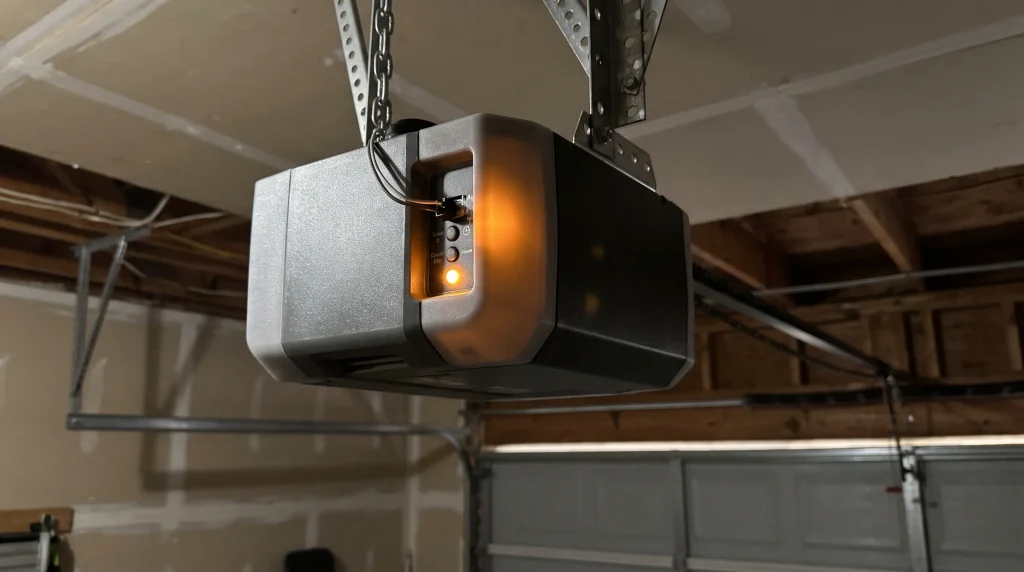
How to tell if your garage door opener is still running on battery power
What you’ll notice: Beeping about every 2 seconds and a solid orange battery light on LiftMaster and Chamberlain openers. The door still works, but the opener is running on its backup battery.
Why it happens: The opener lost wall power and switched to the battery. Chamberlain’s first troubleshooting step is simply to confirm whether the power in your home has come back on. Outages here can be very local. In June 2022, a single strong storm cell knocked out power to about 3,000 AES Ohio customers around Xenia. AES Ohio also notes that homes on opposite sides of the same street can be fed by separate connections, so your neighbor’s lights being on doesn’t mean yours will be.
How to check it:
- Flip on a light or two inside the house.
- If the house is dark, the opener is doing its job. Report the outage to AES Ohio at 877-4OUTAGE (877-468-8243) instead of assuming someone else already has.
- Go easy on the door while you wait. A fully charged Chamberlain backup is designed for 24 hours of standby and up to 20 full cycles at room temperature. Genie rates the integrated battery on its SilentMax LED Connect for up to 50 cycles after a power failure. A cold garage will give you less.
- If the house has power, move on to the next check.
If your opener beeps even when there hasn’t been an outage, our master guide, Why Is My Garage Door Opener Beeping? 7 Common Causes and How to Stop It, covers every other cause.
Safety warning: If you run a portable generator during an outage, keep it outside and at least 20 feet from the house. Never run it in the garage. Opening the garage door won’t provide enough ventilation to prevent a deadly buildup of carbon monoxide.
Call a pro if: the whole house has power, but the opener stays on battery after you’ve worked through the rest of this list.
2. Does the Opener’s Outlet Have Power?
How to test the ceiling outlet your garage door opener plugs into
What you’ll notice: The house has power, but the opener keeps beeping with a solid orange light.
Why it happens: Power isn’t reaching the opener’s outlet, or the plug has worked loose. Chamberlain’s advice for this exact situation is to test the outlet by plugging in a different device.
How to check it:
- Close the door if you can, then unplug the opener.
- Plug a lamp or phone charger into the same outlet.
- If the lamp works, plug the opener back in firmly and watch the battery light.
- If the lamp doesn’t work, the outlet has lost power. Go to check 3.
Call a pro if: the outlet has power but the opener still shows a solid orange light after you plug it back in. The opener may not be reading wall power correctly.
3. Did a GFCI Outlet or Breaker Trip?
How to reset a tripped GFCI or breaker after a power outage
What you’ll notice: The opener’s outlet is dead, even though the rest of the house has power.
Why it happens: GFCI outlets and breakers can trip when power drops out or comes back. GFCI protection has been required for garage wall receptacles since 1978, and a single GFCI outlet can protect other outlets on the same circuit. That means the tripped outlet may be somewhere else in the garage, not the one the opener plugs into.
How to check it:
- Look for outlets with Test and Reset buttons in the garage, on the outside walls, and near any basement or laundry area.
- Press Reset firmly on each one.
- Check your breaker panel for a breaker sitting in the middle or off position. Switch it fully off, then back on.
- Test the opener’s outlet with a lamp again.
Call a pro if: the GFCI trips again as soon as you plug the opener back in. A fault inside the opener can cause that, so leave it unplugged and schedule garage door opener service. If a breaker keeps tripping with the opener unplugged, call an electrician.
4. What Is the Battery Light Telling You?
What the solid orange, flashing orange, and green lights mean after an outage
What you’ll notice: The battery light on the motor unit, located near the top of the Learn button on LiftMaster and Chamberlain openers.
Why it happens: The light tells you where the opener is getting its power and how the battery is holding up:
- Solid orange, beep about every 2 seconds: the opener is still running on battery power. Go back to checks 1 through 3.
- Flashing orange, beep every 30 seconds: the battery is low. After a long outage, that often just means it drained.
- Flashing green: wall power is back and the battery is recharging. This is normal after an outage.
- Solid green: the battery is fully charged, so you’re all set.
- Solid red: the battery has drained and can’t recharge, so it needs replacing.
How to check it:
- With the power back on, give a drained battery time to recharge.
- If the light stays flashing orange or turns red once wall power returns, the battery was likely worn out before the outage hit. Walk through the fix in Why Does My Garage Door Opener Beep Every 30 Seconds? 5 Steps to Fix a Low Backup Battery.
- LiftMaster and Chamberlain owners can find the full battery light guide for their model starting from Chamberlain’s official website.
No battery light at all? Your opener probably has no backup battery, which means it simply stops during an outage. A garage door opener installation with a built-in battery backup keeps the door working the next time the power goes out.
Call a pro if: a new battery still won’t charge once wall power is back.
5. Is the Door Still Disconnected From the Opener?
How to reconnect a garage door after using the emergency release
What you’ll notice: You hear the opener run, but the door doesn’t move.
Why it happens: If you pulled the red emergency release cord during the outage, the door is still disconnected from the opener’s trolley. Chamberlain’s troubleshooting notes that when you hear the opener running but the door stays put, the door may be disconnected from the trolley, and the fix is to reconnect it.
How to check it:
- Close the door by hand.
- Reset the emergency release the way your owner’s manual describes. On many openers, the trolley reconnects automatically the next time you run the opener.
- Run the opener from the wall button and watch the trolley catch the door.
- If you’re not sure how your model reconnects, Genie’s model instructions and support are available on Genie’s official store and support site, and your manual covers other brands.
Safety warning: Pull the release cord with the door closed whenever you can. An open door can drop fast if a spring is broken. If the door feels far heavier than normal when you lift it, stop and read our guide to manually opening a garage door with broken springs before going any further.
Call a pro if: the door won’t reconnect, or the opener runs and the trolley still doesn’t move after you reconnect it.
6. Did a Power Surge Damage the Opener?
Signs of garage door opener surge damage after the power comes back
What you’ll notice: The outlet has power, but the opener won’t respond, responds only some of the time, or the wall button and remotes stop working together.
Why it happens: Power often comes back with surges. FEMA advises unplugging appliances and electronics during an outage so a surge can’t damage them when the power returns. An opener’s circuit board is exactly the kind of electronics a surge can take out.
How to check it:
- Unplug the opener for a minute, then plug it back in to reset the electronics.
- Try the wall button and a remote.
- Watch the battery light. If it doesn’t come on at all, or the opener stays unresponsive, the board may be damaged.
- After any electrical issue, run a safety reversal check. Our guide shows how to test your garage door’s safety features at home.
Call a pro if: the opener is still dead or erratic after a reset. A damaged logic board calls for garage door opener repair. Don’t keep cycling an opener that’s acting unpredictably.
DIY or Call a Pro? Post-Outage Beeping at a Glance
Which garage door opener outage problems can you fix yourself?
| What you see or hear | What it means | DIY-safe fix | Call a pro when |
| Beep every 2 seconds, solid orange light, house is dark | Opener is on battery power during the outage | Limit trips, report the outage, wait | The battery dies and the door won’t release safely |
| Beep every 2 seconds, solid orange light, house has power | Outlet, GFCI, or breaker problem | Test the outlet, reset GFCIs, check the breaker | The GFCI trips again when the opener is plugged in |
| Beep every 30 seconds, flashing orange light after the outage | Battery drained or worn out | Let it recharge, then replace it if the beeping continues | A new battery won’t charge |
| Solid red light | Battery can’t recharge | Replace the battery | The light stays red with a new battery |
| Opener runs, door doesn’t move | Door still disconnected from the trolley | Reset the release and run the opener | It still won’t move, which can point to stripped opener gears |
| Opener dead or erratic, outlet has power | Possible surge damage | Unplug for a minute and plug back in | No change after the reset |
| Beeping and flashing lights right before the door closes | Timer or app warning, not the outage | See Why Does My Garage Door Beep Before It Closes? 4 Reasons | The door closes with no setting behind it |
| Chirp every 30 to 60 seconds from a ceiling or hallway | A hardwired smoke or CO alarm’s backup battery ran down during the outage | Replace that alarm’s battery | Three or four loud beeps: get out and call 911 |
If a surge took out an older opener, check its age before paying for a new circuit board. Every residential opener manufactured for sale in the U.S. since January 1, 1993 has to meet the federal entrapment protection standard, 16 CFR Part 1211, which you can read in full through Cornell Law School’s Legal Information Institute. If yours predates that standard or has already needed several repairs, garage door opener replacement is usually the smarter spend.
Be Ready for the Next Outage
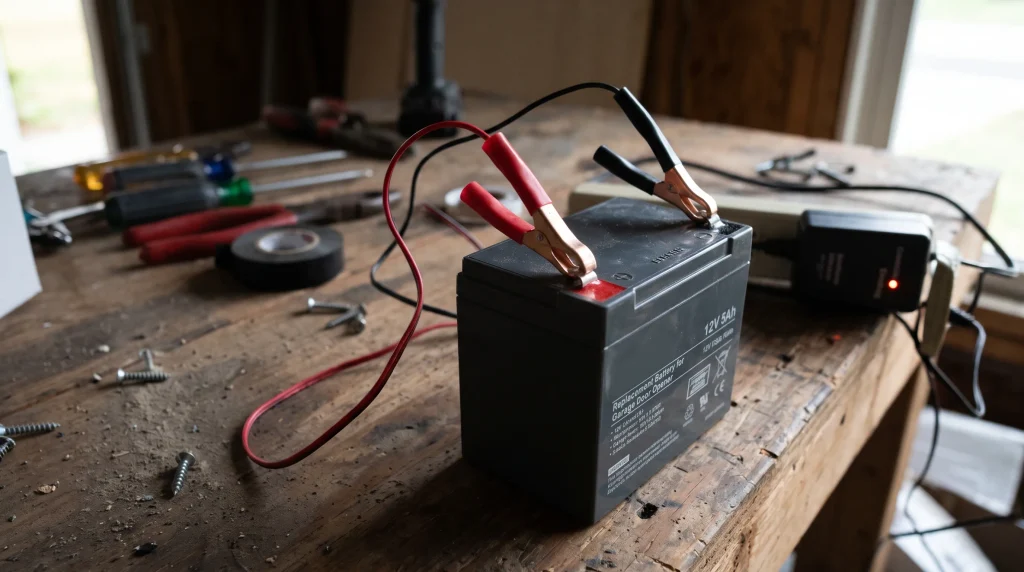
Garage door opener help after a power outage in Xenia, OH
Most post-outage beeping ends with a reset GFCI, a plugged-in cord, or a battery that just needs time to recharge. To stay ahead of the next storm, test your backup battery before storm season, sign up for Greene County’s Hyper-Reach emergency alerts through the county EMA, and bookmark AES Ohio’s website to report outages and follow restoration updates.
If your opener is still beeping, won’t respond, or took a hit from a surge, Dodson Garage Door can track down the problem and get your door running again. Contact our team to schedule your post-outage service visit today.
Frequently Asked Questions
Is it safe to use my garage door while it's running on battery power?
Yes. The battery backup is designed to run the door during an outage, and the beeping is just a reminder that you're on battery. Keep trips to a minimum, since the battery only holds a limited number of cycles, and keep the door closed when you don't need it.
How long will my backup battery keep the door working during an outage?
It depends on the opener and the battery's age. A fully charged Chamberlain backup is designed for 24 hours of standby and up to 20 full cycles at room temperature, while Genie rates its SilentMax LED Connect for up to 50 cycles. Cold garages and older batteries both cut those numbers down.
Why won't my garage door open after the power came back on?
Start with the simple causes: a tripped GFCI or breaker, a loose plug, or a door that's still disconnected from the emergency release. If the outlet has power and the door is connected but the opener won't respond, a surge may have damaged the circuit board.
Do I need to reprogram my remotes after a power outage?
Usually not. In our experience, outages rarely erase remote programming. If your remotes stop working after an outage, check the remote's battery and make sure the lock feature isn't turned on at the wall control before reprogramming anything.
Can a power outage damage my garage door opener?
The outage itself usually doesn't, but the surge when power returns can. That's why FEMA recommends unplugging electronics during an outage. If your opener goes dead or starts acting erratically right after the power comes back, surge damage is a strong possibility.
Should I unplug my garage door opener during a power outage?
If you won't need the door for a while, unplugging it protects the electronics from a surge when the power returns. On openers with an integrated backup battery, the battery can still run the door while the opener is unplugged. Plug it back in once the power is stable.
How do I open my garage door during an outage if the battery is dead?
Pull the red emergency release cord, ideally with the door closed, and lift the door by hand. It should feel manageable with working springs. If it feels far heavier than normal, stop, because a spring may be broken. Get help or leave it for a technician.
How do I get into my garage during an outage if I'm outside?
With a working battery backup, your remote or keypad should still open the door. Without one, you'll need another way in, since the emergency release cord is inside the garage. Our rule of thumb from the field: if the garage is your main entrance, a battery backup opener is worth having.
How much does it cost to fix a garage door opener after a power outage?
It depends on what went wrong. Resetting a GFCI or reconnecting the door costs nothing. A replacement battery is a modest parts cost, while repairing surge damage to a circuit board or replacing the opener costs more. We'll quote the price before starting any work.